Asia/Kolkata
BlogJanuary 4, 2025

How ALU (Arithmetic Logic Unit) Works

Vaibhav Jha
This article is part of the Vaibhav Jha technical writing series on backend systems, software architecture, and core computer science topics explained with practical developer context.
How ALU (Arithmetic Logic Unit) Works
The Arithmetic Logic Unit (ALU) is a core component of the CPU responsible for performing all arithmetic and logical operations. Every calculation—from simple addition to complex decision-making—ultimately passes through the ALU.
The ALU performs two main types of operations:
  • Addition
  • Subtraction
  • Multiplication (sometimes delegated)
  • Division (often handled separately)
  • AND
  • OR
  • NOT
  • XOR
  • Comparisons (greater than, less than, equal to)
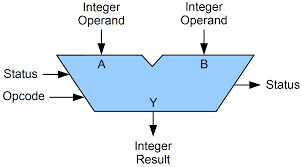
  1. CPU sends instructions to the ALU
  2. Operands are fetched from registers
  3. ALU processes the operation
  4. Result is stored back in registers
This happens in a single clock cycle for simple operations.
The ALU is built using digital circuits:
  • Half adder
  • Full adder Used for binary addition.
  • AND, OR, NOT, XOR Used for logical operations.

Select which operation result to output based on control signals.
Adding two numbers:
Share this post: